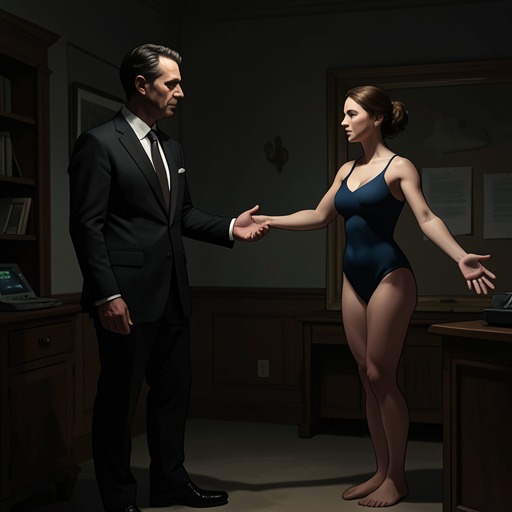
Marion brings Patrick to Peacehaven and urges Tom to see him
My PolicemanMarion Taylor’s effort to bring Patrick Hazlewood into the home she shares with Tom Burgess becomes a painful attempt to reopen a relationship Tom has left unspoken for years. In Peacehaven in November 1999, Marion hopes Patrick’s presence—and the fact that he has called Tom’s name—will persuade her husband to face him. Instead, Tom refuses, answering her appeal with the accusation that Patrick needed him long ago.
Setting and Circumstances
The episode is framed as Marion’s address to Patrick, from a Wednesday in November in Peacehaven at the end of the twentieth century. Rain and wind press against the windows. The weather recalls another rain-soaked day: Marion and Tom’s wedding on 29 March 1958. At the time, Marion had imagined the downpour as a baptism into a new life; looking back from the present, she finds the wedding day more vivid than the dreary one in which she is writing. That contrast gives her account its tension: the promise attached to the marriage remains close, while the life built around it has become marked by distance and silence.
Patrick is now in Marion and Tom’s home after two major strokes. Tom says the doctor has warned that another stroke is only a matter of time, and insists Patrick cannot speak and will never speak again. Marion’s hope rests on a small but consequential exception: Patrick has uttered Tom’s name. She presents this as a reason for Tom to visit, although she recognizes that there has been no further word since that moment and admits to exaggerating the improvement. The scene does not establish that Patrick can recover speech; it shows Marion treating the name as an opening that might still draw the two men together.
Marion’s Intervention
Marion reveals that bringing Patrick to Peacehaven was her decision, not Tom’s. Tom did not want him there; Marion says she insisted, something she had never done with comparable force during more than forty years of marriage. Her action is therefore both practical care for a man who has no one and a deliberate effort to make Tom confront a relationship he has kept at a distance. She asks Tom to come into Patrick’s room, look at him, and recognize that Patrick still loves him. She hopes this encounter will break Tom’s silence.
The change Patrick’s arrival makes to the household is visible in its ordinary routines. Marion had hoped Tom would join them at what Nurse Pamela calls the ‘family table’, but he no longer even breakfasts with them. His absence had once been a relief to Marion after what the couple had endured; now she wants him beside her and beside Patrick. The altered feeling matters: she is not simply trying to restore an old intimacy between the men, but asking Tom to share the present work and presence of caring for Patrick.
Marion has also given up her Tuesday volunteering at the local primary school since Patrick came. Tom used to stay indoors on those days; now he walks Walter across the downs every day of the week. He swims each morning at Telscombe Cliffs, even in icy water, for no more than fifteen minutes, and remains active at sixty-three, watching his weight, rarely drinking, walking the dog, and watching documentaries about real-life crime. These habits make his withdrawal from Patrick sharper: he keeps himself busy and physically disciplined, yet, Marion says, talks to no one, least of all to her. Her hope that he will enter Patrick’s room is set against a household in which routine continues but conversation has nearly disappeared.
Tom’s Refusal
When Marion raises the subject, Tom groans that it is late. She tells him Patrick asked for him and called his name. Tom challenges her account, saying Patrick did not say her name, and then turns to the medical prognosis: Patrick has had two major strokes, cannot talk, and will never talk again. Marion replies that there has been a real improvement, while acknowledging to Patrick that she knows she is exaggerating. Her plea depends less on certainty about recovery than on the possibility that Tom might respond to the name Patrick spoke.
Tom rejects both her interpretation and her attempt to involve him. He says they have been through this already, cannot understand why she brought Patrick into the house, and does not know what scheme she has in mind. He allows that she can play nursemaid if she chooses, but tells her not to expect him to take part. Marion answers that Patrick has no one and is in pain; he needs Tom. Tom’s response—‘He needed me years ago, Marion’—turns the appeal backward. Where Marion treats Patrick’s present dependence as a reason to come closer, Tom names an earlier failure as the decisive fact. He leaves the room without agreeing to see Patrick.
Consequences and Significance
The encounter does not bring about the reconciliation Marion wants. Tom’s refusal leaves Patrick’s call unanswered and exposes the unresolved hurt behind Tom’s silence. Marion’s insistence has succeeded in placing the request plainly before her husband, but not in making him accept it. The immediate result is a sharper division: she is caring for Patrick and hoping for shared attention, while Tom continues to withdraw from both of them.
The scene’s force comes from the difference between what Marion can offer and what Tom will acknowledge. A spoken name, perhaps the only one Patrick has uttered since his stroke, becomes for Marion a reason to hope; for Tom, it cannot erase the years in which he believes Patrick needed him. The present-day request is consequently also an encounter with the past, though the account supplies no resolution between the men. By narrating directly to Patrick, Marion makes him the intended witness to her attempt: she explains that Tom did not want him there, that she insisted, and that she still wants Tom at his side. The hoped-for breaking of silence remains just that—a hope, set against Tom’s final departure.